Monday, July 23, 2018

Fostering a Sense of Belonging: Incorporating Women into Your Public Administration Curriculum


Fostering a Sense of Belonging: Incorporating Women Into Your Public Administration Curriculum
Megan E. Hatch
Cleveland State University

Summer for me is a time of deep reflection. Thinking about finishing lingering projects, starting new research projects, my courses. This year, the last one is particularly salient. I am spending this summer focusing on revising the curriculum of two of the most important courses in our MPA program: the introductory course and the capstone. The necessity of getting this right cannot be overstated. For most students, the MPA is a terminal degree, so this is the opportunity to introduce them to the history, norms, and expectations of public administration. Certainly they will learn more as they continue their careers, but if they are not satisfied with their introduction to the field they may not continue in public service.

One thing I keep returning to is the importance of showing my students there is a place for them within public administration. Regardless of their gender identity, race, age, sexual orientation, religion, disability, or anything else, they can make a difference in their community. Many students already have public service motivation, so I see my role as cultivating a sense of belonging. To me, belonging comes from understanding the diversity of public administration. That is a topic I cannot possibly do justice to here, so instead, I will focus on the topic of my recent article in the Journal of Public Affairs Education (JPAE)―gender. Some of my favorite articles to get you started on other topics are by Vanessa Lopez-Littleton and Brandi Blessett, Domonic A. Bearfield, and a 2011 JPAE symposium.

In my JPAE article, I make the argument that the 3 Cs (content, context, and concepts) need to be aligned. By this, I mean the concepts we teach in the classroom, which are reflected in the content of readings, activities, and lectures, should match the context of the on-the-ground experiences of public administrators. Yet, this is not the case today. If you were to look at a typical MPA syllabus, you would think the field is dominated by men. I found on average, less than 20 percent of authors assigned in top-ranked MPA programs’ introductory courses were female and never was that over 42 percent. With an average of 59 percent of students enrolled in NASPAA-accredited programs identifying as female, it is clear women are an integral part of public administration.

One way to make women feel included in public administration is to include more women in our syllabi. When I say that, the common response is “But the founders of public administration were men.” It is true, Wilson, Gulick, Simon, Waldo, Wildavsky, and a host of others were (white) men. But that does not mean women were not part of public administration from the beginning. Camilla Stivers’ groundbreaking book should not be forgotten: as the field took a turn towards a scientific approach, women’s methods and contributions were devalued. This, coupled with the observation that women originally published less than men in public administration journals, lends credence to the idea that the field is dominated by men. However, since the late 1990s, this gender bias has been changing and even eliminated by controlling for mitigating factors . In fact, women are now more likely to publish in top-tier journals. While the contention that the founders of the field were all men remains prevalent, it is neither an accurate representation of the field today nor of public service historically. Those of us with Ph.D.’s in Public Administration probably had a comprehensive exam reading list dominated by men. Often instructors teach what they were taught, perpetuating this dominance of male authors. If like me, summer is a time of reflection for you, I implore you to stop this cycle and revise your curriculum to reflect the contributions of women.

How can you do this, given the earlier observations that men originally published more in public administration journals, and the “classics” are written by men? I have a variety of recommendations in my article, and others have suggestions as well, but I want to focus here on incorporating research by women into your curriculum.

There is undoubtedly value in learning our field’s history. In fact, I believe it is essential for students to understand the various iterations and themes, from the politics/administration dichotomy to Scientific Management to New Public Administration and New Public Service. Yes, many of the original articles and books on these topics were written by men. But those were not the final words written on the topics. An easy way to incorporate more women in your syllabus is to pair a male-authored “classic” with something a woman wrote. Some of my favorites include complementing Woodrow Wilson with the Perspectives on Politics symposium on his legacy, Martha Derthick with the Federalist Papers,  Norma Riccucci with Michael Lipsky and street level bureaucrats, and Deborah Stone with Herbert Simon and bounded rationality. When teaching budgeting, leadership, nonprofits, bureaucracy, or performance management, there are plenty of established and early career female scholars whose work will only enhance student understanding of these topics. There is nothing in the Laws of Teaching Public Administration ™ that say readings must be at least 50 years old. If anything, newer articles and books help students understand what they can expect as they enter the field.

This devaluing of women scholars is not unique to public administration. Jeff Colgan has an excellent article on this process in internal relations. The group Women Also Know Stuff was founded after a media article cited several influential political scientists, all of whom were male. The Women Also Know Stuff movement includes a website with a database of women scholars by specialty, Twitter account, and an explanatory journal article. That database has a listing of 76 women public administration scholars, by the way. They inspired other organizations, including Academic Women in Public Administration (AWPA), a group in which I am a board member. Search our database and you will see a list of almost 400 women scholars in the field. Our Twitter account frequently highlights new articles and books by women. We host meet-ups and panels at conferences. All those resources are places to look to see the myriad of ways women are contributing to the field.


After you have made these changes, use the Gender Balance Assessment Tool (GBAT) developed by Jane Lawrence Sumner to test the gender balance of your syllabi. Feeling ambitious? I hope you are. Do not stop there. What I have offered you is a mostly technical solution to an adaptive problem. We also need systematic change to the structures and philosophy of the field. That is hard work, but is the only way to incorporate marginalized groups fully into public administration. I recommend starting by thinking about who is left out of your curriculum, why, and how you can incorporate those other voices. I am not claiming this is easy; in fact, I can personally attest to how difficult it is. I am going to be spending a lot of time this summer working on those two courses, and they will not be perfect. Incorporating diversity into our curriculum is a never-ending process. But it is an essential one if you want, as I do, to foster a true sense of belonging among our public administration students.

Thursday, July 19, 2018

Response to: Big Questions Surrounding Gender Equity

Response to: Big Questions Surrounding Gender Equity
Arizona State University
Academic journals play a crucial role in both the creation of knowledge and the career advancement of scholars (‘publish or perish’ as the mantra goes). As a result, journal editors serve a pivotal and critical role in the world of academia. In effect, they serve as gatekeepers, with the power to decide what gets published and what doesn’t.
In the realm of Public Administration, although the representation of women has increased over the years (which is to be commended), this doesn’t appear to be reflected on editorial boards.
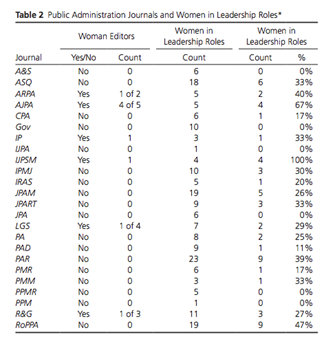
Concerned about this and wanting to document the current state of play, colleagues Associate Professor Mary Feeney at ASU, Associate Professor Helen Dickinson and I from UNSW collected information about the top 24 Public Administration journals.
When we analysed the data, we found that only six had women in lead editor roles, that a quarter didn’t have any women in leadership roles, and that six journals only had one woman in an editorial leadership position. When it comes to review boards (those that do the bulk of reviewing) women made up less than 30%. In contrast, we found an over-representation of women in lower status positions such as book review roles.
Reflecting on this, we argue that this type of inequity is structural and thus changeable. We suggest a range of personal, interpersonal and structural strategies to improve the representation of women on editorial boards. These include (but not limited to) things such as encouraging under-represented candidates, ensuring departmental support and developing transparent journal processes.
As a field that advocates for transparency in government practice, we argue that it’s time we collectively raise our expectations for transparency in our scholarship.
Whilst Public administration has come a long way towards achieving gender diversity in our classrooms and increasingly in our faculty ranks, it’s yet to reach our journal leadership, and we argue it needs to. Now with a baseline documented, only time will tell how the field reacts and if greater diversity will be achieved into the future.
For more details, you can read the full paper here in Public Administration Review.
By Lisa Carson, on behalf of Mary Feeney & Helen Dickinson

Monday, July 9, 2018

Response to: Big Questions Surrounding Gender Equity

Response to: Big Questions Surrounding Gender Equity
Patricia M. Shields, PhD
Texas State University
When I entered the field of public administration, gender equity was framed by simpler concerns. It focused on the underrepresentation of women in MPA programs and among MPA faculty. There was perhaps a tacit assumption that as women’s presence grew, their impact on the theory, scholarship and practice of PA would grow accordingly. Maria D’Agostino and Nicole Elias’s blog post examine a world where this has yet to happen. They place some of the responsibility for this on women’s lack of representation on editorial boards and in the position of editor-in-chief.

I concur. Decisions about what and who to grace the pages of PA and Policy journals influence the content and leadership of our field. The Feeney et al. (2018) PARarticle “Power in Editorial Positions” made this clear. This article called for more transparency and voiced concern about bias. All of their arguments made sense. While we do not want editors or editorial boards to be bias, they are selected for their expertise and judgment. This judgment guides their decisions about the nature and future of the field. When women are missing from these positions, their guiding judgments are missing. I believe the field would be stronger if these guiding judgments reflected greater diversity. Voices, which now feel marginalized, can be better synthesized.

A commitment to increase the presence of women on editorial board and in the decision-making role of editor, is about the future of PA. I believe we should also turn our attention backward and re-imagine our past. A history of PA absent women is a contemporary problem. We need to find and re-integrate women into our historical narrative. Women’s contributions may not fit the neat categories that provide us with the stories of our founding fathers. We will need to look in unorthodox places and make the connections. The women are there, they were just marginalized and often pushed over into social work. Non-profit administration offers another avenue of investigation.

Even without the authority of the vote, women organized to recreate their communities. Theda Skocpol’s (1995) Protecting Soldiers and Mothers: The Political Origins of Social Policyand Cam Stivers (2000) Bureau Men and Settlement Womenare examples of work that should be part of mainstream PA history. I feel certain that if we look into social work, particularly the branches that focus on policy and advocacy, we will find many amazing pioneers of public administration. We need a historical pluralism and revisiting and reintegrating the work of women at the time of the founding is one way to do this.

Nicole and Maria asked me to contribute to the discussion because I have edited a journal for almost 18 years. Armed Forces & Societyis on the SSCI for both political science and sociology. It is international and interdisciplinary and looks broadly at social science and policy issues, which emerge as military and society intersect. Subjects we entertain include veterans, military families, gender integration, base closures, privatization, democratic control and mental health. About 15 percent of our submissions come from faculty in public administration or policy schools.

I published my dissertation, which examined the equity of the draft during the Vietnam era in Armed Forces & Society. The organization that owns the journal, Inter-university Seminar on Armed Forces and Society, was begun by military sociologists. Throughout the 1980s and 1990s leaders in this organization offered me many opportunities to expand my scholarly horizons, particularly in the areas of military recruitment, women and family issues. During that time, I attended conferences, participated in invited policy forums, contributed three journal articles, wrote nine book reviews and reviewed about three manuscripts a year. All of these activities contributed to the invitation in 2000 to become the editor-in-chief of Armed Forces & Society.  

In that role, I have been able to exercise that editorial judgment and influence the scholarship of civil-military relations. One surprising way I did this was to assign more European reviewers to manuscripts about the US military. I believed these papers often needed a more international perspective. Only later did I learn that European scholars were pleasantly surprised that they would be asked to comment on papers about the US military. They also began recommending Armed Forces & Societyas a publication outlet to more of their colleagues. The US authors responded positively as their assumptions were challenged and horizons widened.  The tone and scope of these articles improved in unexpected ways. I use this as an example of how seemingly small editorial decisions (who receives reviews) can influence scholarship. I also believe that my perspective as a woman contributed to that editorial decision.

I have several suggestions for how to increase the visibility of and impact of women’s ideas and scholarship in PA. First, don’t be shy. Promote your ideas and scholarship. Present at conferences, use social media platforms like Academia.edu and Research Gate. Cite yourself. Second, find a network of likeminded scholars and publish with them. Cite each other. Third, review for journals. Believe it or not, strong reviews set you up as a possible editor. In these reviews, when appropriate, suggest additional works by women be integrated into the literature. If your work fits, include it too. Fourth, have an active research agenda with manuscripts in various stages of completion. Learn from reviews. Figure out how the comments can contribute and make the changes. I had one particularly nasty and mean-spirited review. After a period of shock, I thanked my stars that I was not married to that jerk and revised taking into account the useful stuff. The line on my vita is sweet revenge.

Tuesday, July 3, 2018

Big Questions Surrounding Gender Equity in Academia and the Field of Public Administration


Maria J. D’Agostino
@MJDPhD


Nicole M. Elias
@NicoleEliasPhD


During the 2017-2018 academic year, sex and gender dynamics became a primary focus across disciplines. For example, central topics included: under representation of women in academic leadership and scholarship, gendered content within top journals and editorial board membership, and the #MeToo movement prompting sexual harassment and assault within academia and campus settings to come to light. This interest in gender taking form underscores the need for MPA curricula to promote gender competency for faculty, students, and future practitioners alike. Organizations such as Women in the Public Sector at John Jay College, ASPA’s Section for Women in Public Administration, and Academic Women in Public Administration have taken steps to further understanding, collaboration, and fruitful projects that promote greater gender equity in the field of public administration.


As we are start our summer projects, and catch up on all our reading and writing,  we should take time to pause, reflect, and engage in discussion on recent research and women’s roles that focus on women in academia and public administration. Here, we highlight recent scholarship that embodies these critical issues for women. We invite reflection, responses, and ongoing dialogue considering next steps for addressing these challenges and proposing new ways of thinking and taking action.   


Women in leadership are underrepresented across all fields, including academia. The need for more women in top management roles is discussed as part of the #MeToo movement to counter the existing power imbalances in organizations. In their 2018 Journal of Public Affairs Education article, Gender and the Role of Directors of Public Administration and Policy Programs Stabile, Terman and Kuerbitz, Stabile, Terman & Kuerbitz assess gender as it relates to director positions in Master of Public Administration (MPA) and Master of Public Policy (MPP) programs. They explore whether women are more likely than men to serve as MPA and MPP program directors and whether men and women report different experiences in the role, such as length of service, rewards and burdens, and possible constraints on research and teaching and thus promotion potential. They found that some gendered characterizations of women’s leadership persist; yet, men and women program directors typically experience similar struggles in balancing their administrative roles with the demands of teaching and research, both of which are likely to suffer during their service. The recent research by Beaty and Davis (2018) Gender Disparity in Professional City Management: Making the Case for Enhancing Leadership Curriculum,  highlights the paucity of women in senior management positions even though there in no lack of women with professional training. They call for the teaching of public administration to reflect it’s changing world by including specific areas of inquiry in the MPA curriculum including why more women do not attain senior executive positions. They conclude that professional training programs can better prepare women for the new world of public administration by making gender more visible within the leadership curriculum.  There is no doubt that the MPA curriculum should highlight sex/gender issues. However, this presents us with another fundamental challenge articulated by Meghan Hatch in (2018), Quiet Voices: misalignment of the three c’s in public administration curriculum, Here, Hatch asks how we achieve greater equity in academia when women write less than 20% of required readings. As Gina Scutelnicu and Hillary J. Knepper emphasize in A Tale of Two Journals: Women’s Representation in Public Administration Scholarship, women publish less than men as solo, lead, and top 10 authors in leading public administration journals.  Meghan Hatch maintains that although scholars preach congruence between “the three C’s” (concepts, context, and content) of public administration in order to keep the field relevant, the content and concepts taught in the MPA classroom do not match the context in the field and provides strategies to address the problem. Beyond addressing these gender imbalances in the classroom,  Feeney et. al. (2018) focus on a root cause of this problem in Power in Editorial Positions: A Feminist Critique of Public Administration. They maintain that women’s representation as journal editors and editorial boards is key to shaping the direction of research in the field because editors are the gatekeepers of what will be published.


Using this recent scholarship as a point of departure, we ask authors, journal editors and board members, those in service leadership roles, and members of academia interested in the topics of representation of women, gendered curriculum content and pedagogy, sexual harassment and assault, and other salient topics to contribute to this discussion.


The responses from authors, journal editors and board members, and leaders in this area of scholarship will be posted.  We, also, would like to invite anyone whom would like to contribute to, please email their contribution to the Women in the Public Sector email account: womeninthepublicsector@gmail.com or wps@jjay.cuny.edu.  

The COVID-19 Pandemic and MPA Education: Student Perspectives on Public Service Values and Public Service Motivation

Closing thoughts on the COVID-19 Pandemic and MPA Education: Student Perspectives on Public Service Values and Public Service Motivation by ...